
People doing real physical work while wearing cameras.
Cooking. Bartending. Manufacturing. Repairing. Assembling. Packing. Cleaning.
That is the basic idea behind egocentric data collection: record work from the worker’s perspective, including what their hands do and how the world responds.
For much of history, physical skill moved from human to human through apprenticeship. Now we can record parts of that apprenticeship at enormous scale and use them to train models.
We now have empirical evidence that scaling human experience can improve robot learning.
The question is what happens as millions of hours become tens of millions, hundreds of millions, then billions.
The million-hour moment
Language models offer a useful comparison.
GPT-2 had roughly 1.5 billion parameters and a 40GB WebText corpus. Call that roughly 10 billion tokens for this napkin calculation. GPT-3 grew to 175 billion parameters and processed 300 billion training tokens. In 2025, Qwen reported approximately 36 trillion tokens for Qwen3 pretraining.

The comparison is approximate: GPT-2’s figure estimates corpus size, while GPT-3’s counts tokens processed during training, including repeated data. [1] [2] [3]
Why compare language to robotics?
Because both involve models learning useful structure from large amounts of experience.
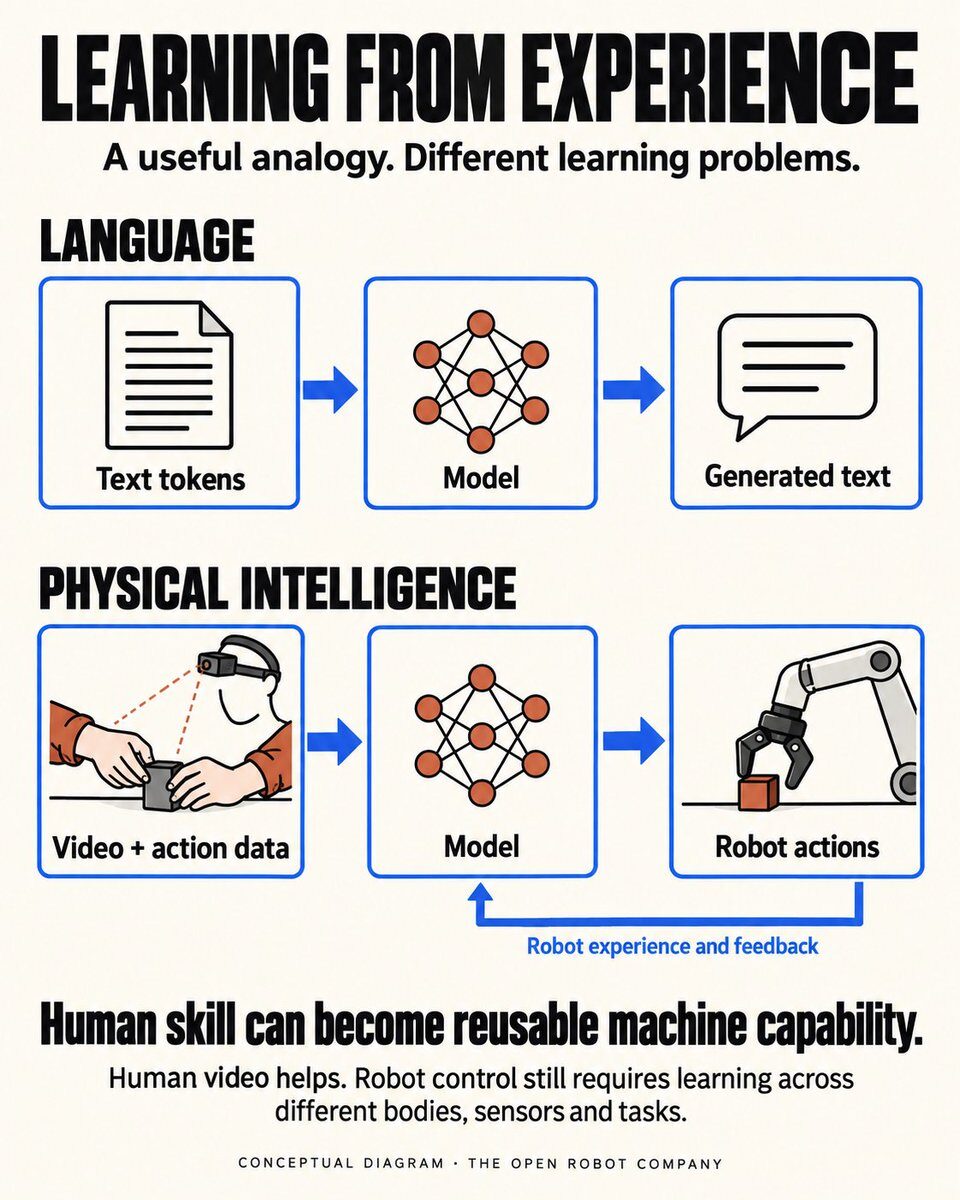
Robot experience and feedback connect human demonstrations to each robot’s body and tasks.
But the shared question is compelling: how much more can a model learn when the experience available to it grows by orders of magnitude?
Three labs. Three pieces of evidence.
Dyna-2: Dyna reports pretraining on more than one million hours of egocentric human video. It tested nested datasets of 1,000, 10,000, 100,000 and 1,000,000 hours, finding better predictions on held-out human and robot data as scale increased. After robot-specific post-training, its average normalized performance across 14 tasks rose from 20% to 53% across that ladder. The score averages task performance normalized to each task’s ceiling. [4]
Generalist GEN-1.5: Generalist reports 59% average success across ten simple, short tasks using a single 3–12 second demonstration and no gradient updates. These “physical prompts” contain sensor data and action trajectories, collected with handheld grippers or from robot rollouts. The result shows rapid adaptation from a pretrained model. [5]
Skild S1: In a controlled comparison at 100,000 hours, Skild reports 66% for demonstration-prompted in-context learning versus 9% for a language-prompted baseline on unseen long tasks. Its metric averages cumulative per-step success on tasks lasting 4–8 minutes. The protocol includes human recovery after failures, mainly for the baseline. [6]
These are company-published results from different evaluations.
There is now measured evidence behind scaling physical experience.
Now do the napkin math
Suppose one million hours is an early reference point for physical AI, comparable in spirit to an early language-model milestone.
Borrow the orders of magnitude from language and ask what the collection effort would look like.
- Starting reference: 1× = 1M
- One order of magnitude more: 10× = 10M
- Roughly the GPT-2-estimate → GPT-3 ratio: ~30× = 30M
- Rounded thousands-fold scenario: 3,000× = 3B
These are hypothetical collection budgets. The 3,000× scenario rounds the roughly 3,600× language comparison for simple arithmetic.
Still: three billion hours sounds almost impossible.
Then you do the math.
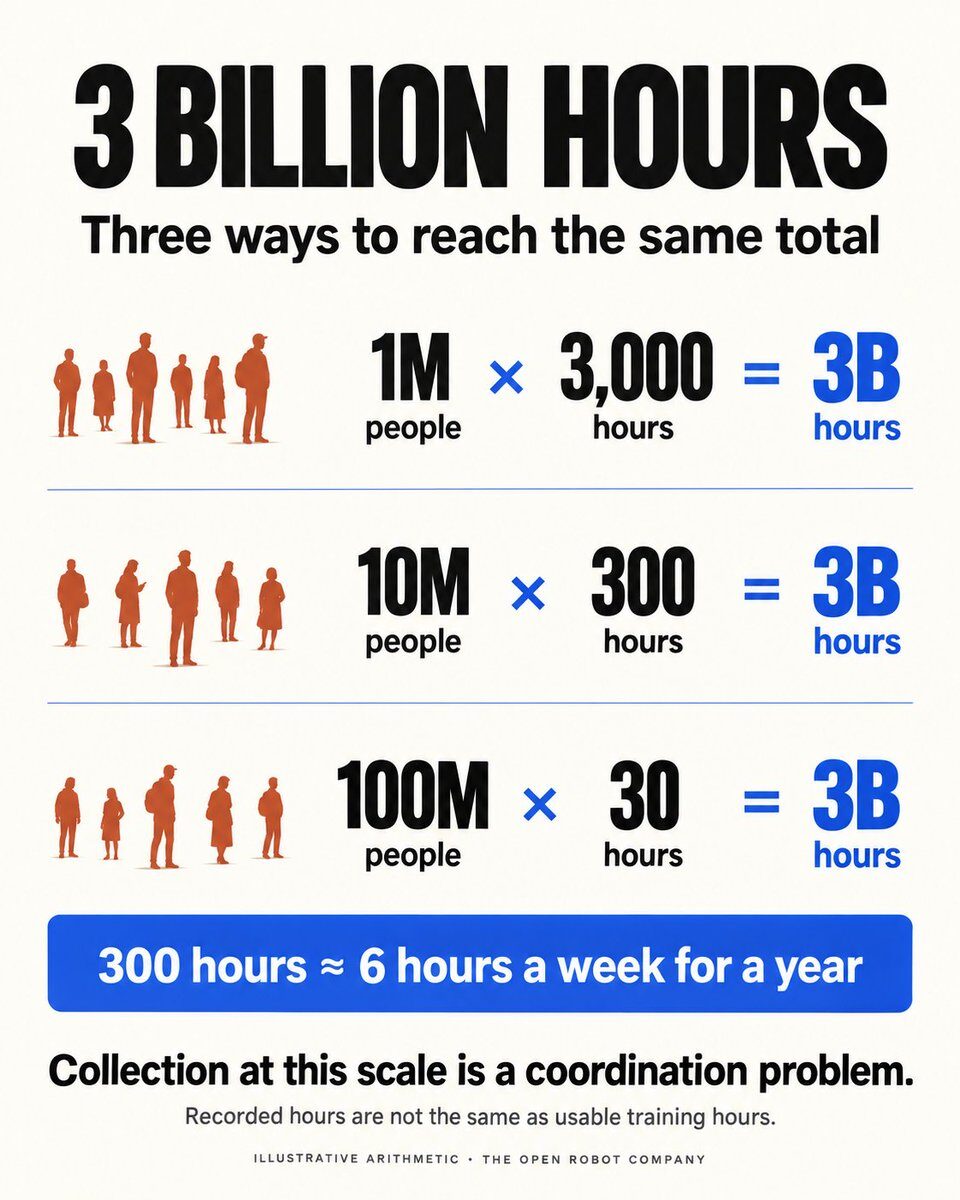
Ten million people doing 300 hours is roughly six hours a week for a year.
A hundred million people doing 30 hours is a few weekends each.
Three billion hours would require coordination at internet scale.
Recruiting people is only the beginning. The footage must capture useful work, meet quality requirements, carry clear usage rights, and reach the buyer in a form their training pipeline can use.
A recorded hour and an accepted training hour are different products. That distinction determines whether a collection business makes money.
The curve can be smooth. The physical economy isn’t.
Dyna’s measured prediction metrics fit power laws over the data scales it tested.
Deployment also depends on thresholds.
Imagine a particular workflow where the business case becomes attractive at 95% task reliability. A robot moving from 94% to 96% could cross that threshold despite a small change in its score.
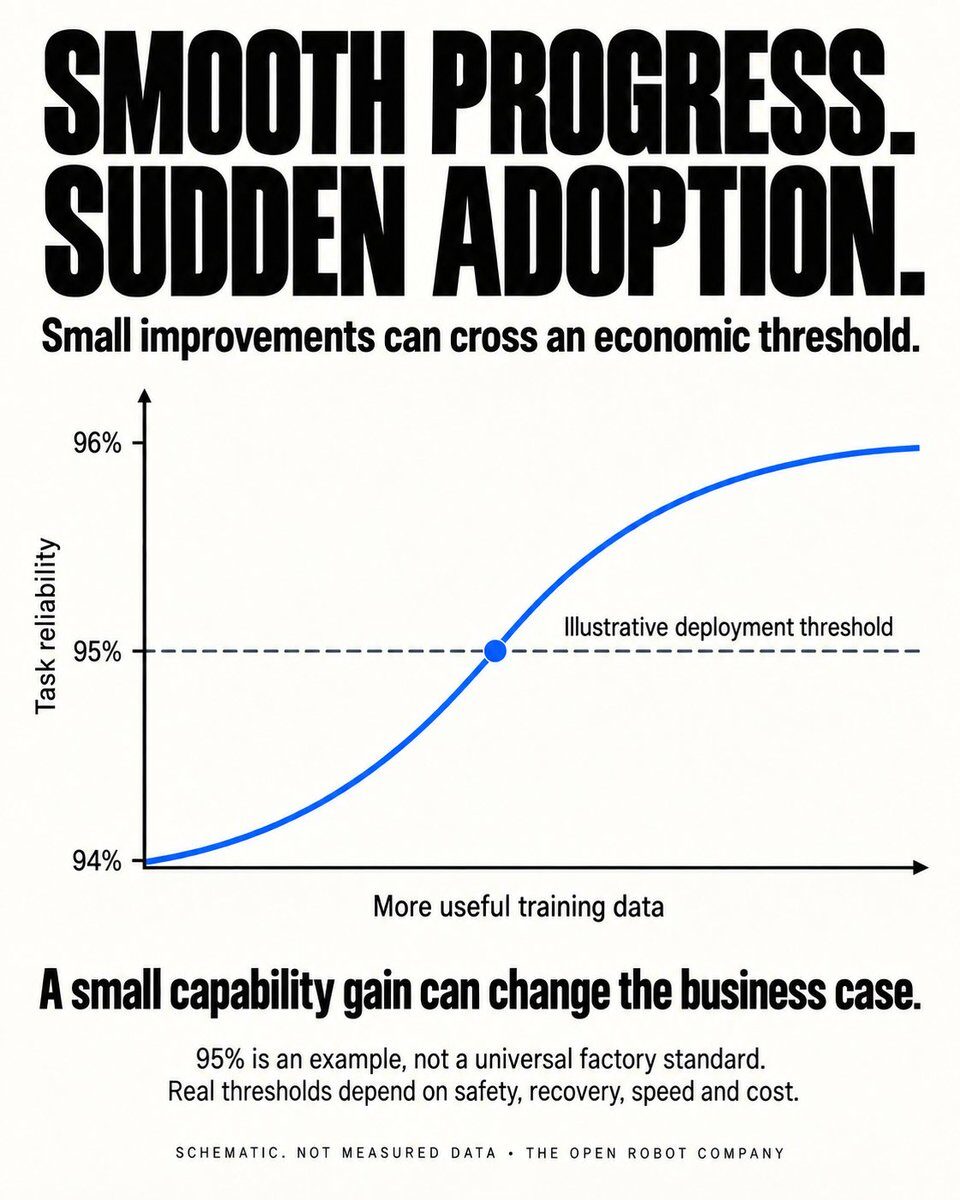
Real requirements depend on what failure costs, whether the robot can recover, how often a person must intervene, and how fast and safely it works.
A smooth improvement in the lab can produce an abrupt change in a deployment decision.
The last apprenticeship
The familiar pattern was:
human → teaches → human
Now another pattern is becoming possible:
human → physical work → recorded experience → model → many machines
The human performs the skill. The machine apprentices.
A human apprentice has to learn the work personally. A trained model can be copied across a fleet.
That is what makes this period strange.
The worker contributing the data may be helping build systems that eventually reduce demand for the skill they are demonstrating.
Automation changes the mix of tasks within a job. Some skills may become more valuable as other parts of the work become cheaper.
But the tension is real. The person doing the work can now also produce the training material for a machine that may do more of it tomorrow.
The human performs the work.
The machine watches.
The machine learns.
Eventually, for more tasks, the apprentice may be able to do the work itself.
Egocentric data collection may be the last apprenticeship of many forms of physical labor.
Who captures the value while the apprenticeship is valuable?
Companies should be able to build valuable businesses from this transition.
Workers, governments and educational institutions should also understand it early enough to participate.
Physical work happens somewhere. The people, workplaces, training programs and data operations that record it can develop into regional industries.
For India, state governments could treat this as an infrastructure opportunity: train collectors and supervisors, build collection programs with real employers, attract foundation-model customers, and develop the operations needed to deliver useful human-motion data at scale.
Workers should understand what they are contributing and be paid for it. Collection businesses should compete on accepted data, reliable delivery and margin. Institutions should build skills that remain useful as the market changes.
Better models may change which demonstrations are scarce and what buyers will pay for them.
That is a reason to capture value and build capability while this apprenticeship is valuable.
The countries that supplied labor to the last industrial era will supply intelligence to the current one.
Sources
- OpenAI, Language Models are Unsupervised Multitask Learners, 2019.
- Brown et al., Language Models are Few-Shot Learners, 2020.
- Qwen Team, Qwen3: Think Deeper, Act Faster, April 29, 2025.
- Dyna Robotics, Dyna-2: A 1-Million-Hour Scaling Law for World-Action Models, August 2026.
- Generalist, GEN-1.5: Embodied Foundation Models are One-Shot Learners, August 19, 2026.
- Skild AI, Introducing S1: In-Context Learning for Robotics, August 2026; listed August 18 on its blog index.